

Green Cities and its partners have launched a 375,000 Euro Nutrition and Organic Uptake for Resilient Inclusive Sustainable Harvest for Family Farms(NOURISH) project.
The project, with a large portion of the funding from the Economic Community of West African States (ECOWAS), Agence Française de Développement, and the European Union, is expected to directly benefit 600 smallholder farmers (360 female and 240 male) and approximately 842,000 indirect beneficiaries.
Speaking at the official launch of the project at the Royal Grand Hotel, Green Cities’ program & business development manager, Dalitso Kuphanga, said the objective of the project is to increase the adoption of quality organic biofertilizers and biopesticides by family farms to improve soil fertility, reduce crop losses, and minimize dependence on synthetic (chemical) agricultural inputs
According to him, the NOURISH Family Farms project seeks to promote diversified crop production and dietary patterns among family farms with the aim of improving household nutrition, strengthening agro-biodiversity, and increasing resilience to climate and market shocks.
Mr. Kuphanga said the project will enhance family farms’ agro-biodiversity, productivity, household incomes, and dietary diversity in Liberia through the promotion of sustainable agroecological practices by 2028.
Kuphanga said the Green Cities Inc. (GCI), Action Against Hunger (AAH), and Say No to Hunger Farmers’ Cooperative (SNoTHFaMCoS) are consortium partners of the NOURISH Family Farms Project.
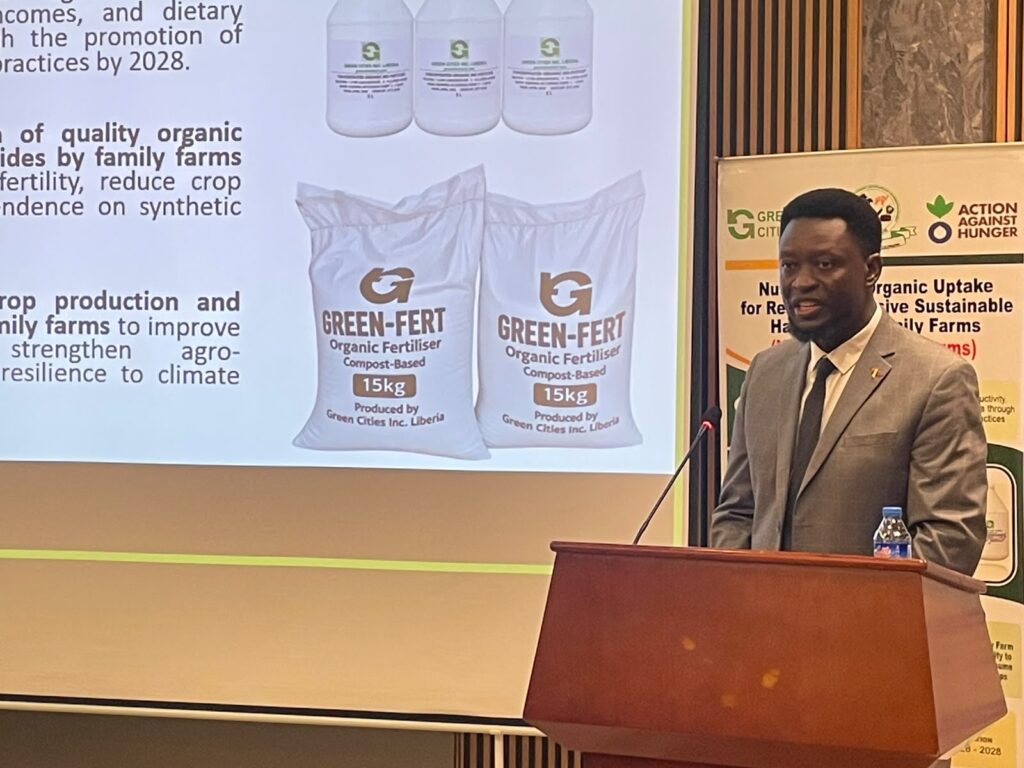
He expressed appreciation to sponsors of the project, promising that the consortium will implement the project to benefit the targeted beneficiaries in the two counties, Nimba and Montserrado Counties.
Earlier, Green Cities General Manager, Marie Kpoto, said, “As we launch today, let’s reflect on key things. The importance of the project, each of our roles and responsibilities, and how well the results will be sustained after the project.”
In a statement read by a proxy of Dr. J. Alexander Nuetah, Liberia’s Minister of Agriculture, the initiative is important for Liberia and Green Cities Inc., Action Against Hunger, and the Say No to Hunger Farmers’ Cooperative for partnering to advance this project to benefit the farmers.
In his statement, the Minister said, “We appreciate the Agence Française de Développement-and the European Union for co-funding this initiative within the ECOWAS framework to promote agroecological innovation in West Africa.”
He indicated that the Government of Liberia also recognizes the important role of ECOWAS in implementing the broader regional framework supporting the initiative.
The Minister stressed that the regional dimension offers Liberia an opportunity to contribute to and benefit from the exchange of knowledge, innovations, and practical experience in sustainable agriculture across West Africa.
Speaking of why the project matters, the agriculture boss said it is because family farmers are at the heart of Liberia’s agriculture sector and are central to the national efforts to strengthen food and nutrition security.
“As we transform agriculture, we must focus beyond increasing production,” he said.
The Minister added, “We need farming systems that are productive, resilient, commercially viable, and environmentally sustainable.”
Minister Nuetah said the NOURISH-Family Farms Project is especially relevant as it integrates agroecology, nutrition, and food security. gender inclusion, and resilient family farming.

“For the Government of Liberia, agroecology must work for the farmers. It must support sustainable production, protect the natural resource base on which agriculture depends, strengthen resilience to climate-related shocks, improve household nutrition, and expand economic opportunities for farming families,” he added.
He cautioned the consortium that farmers must remain at the center of implementation-not simply as beneficiaries, but as partners in identifying, testing, and adopting solutions that meet their needs and realities, adding that, “Agroecological innovations should be practical, locally appropriate, and able to improve farm productivity and resilience.”
The inception and launch program attracted participants from the Paynesville and Monrovia city corporations, partners of the project including the EU, Action Against Hunger, the Environmental Protection Agency, the Liberia Standards Authority and the government of Liberia.
In their separate remarks, they thanked ECOWAS and other funders for providing the funding for the project.
