
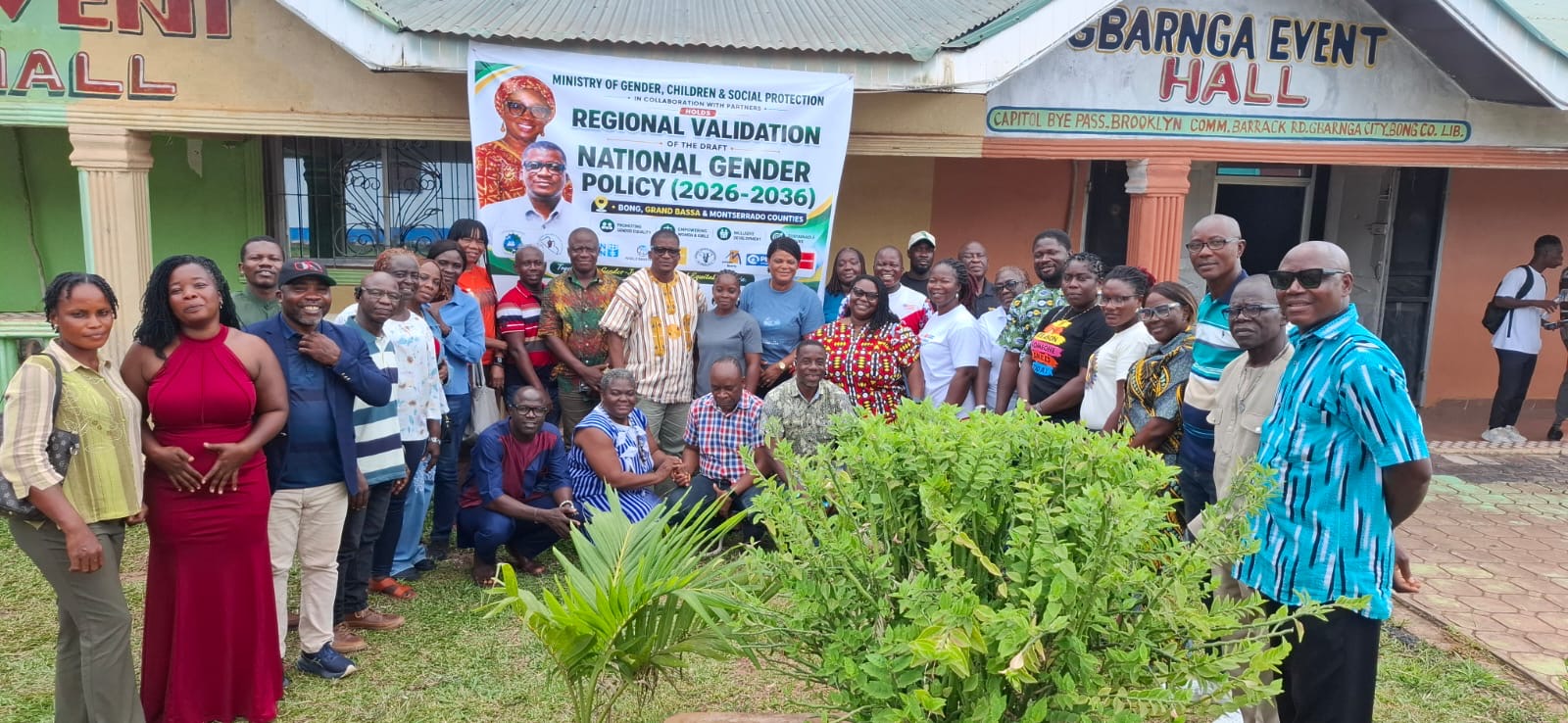
Stakeholders at the regional validation conference
By Emmanuel Kerkulah
The Ministry of Gender, Children and Social Protection (MGCSP), with support from development partners, has concluded a two-day Regional Validation Workshop on Liberia’s National Gender Policy (2026–2035) in Gbarnga, Bong County.
Speaking at the closing ceremony in Gbarnga, the Deputy Minister for Research, Policy and Planning at the MGCSP, Curtis V. Dorley said Liberia’s previous gender policy had expired following the 2018–2022 revision, making the new framework necessary.
Deputy Minister Dorley said a 2025 evaluation recorded a 61% performance rating, with progress in women’s economic empowerment and gender mainstreaming, but also identified persistent gaps.
The 10 years policy introduces a streamlined structure, reducing priority areas from 20 to seven strategic pillars while expanding its scope to Gender Equality, Empowerment and Social Inclusion (GEESI).
He emphasized that key thematic areas validated include gender-based violence, women’s economic empowerment, leadership representation, youth inclusion, education, natural resource governance, and institutional capacity strengthening.
Deputy Minister Dorley stressed that successful implementation will require strong political will, adequate financing, and sustained collaboration among government, development partners, civil society, and communities.
The new policy, he emphasized, will serve as a strategic framework aimed at strengthening gender equality, social inclusion, and women’s empowerment while improving institutional coordination and accountability across sectors.
Deputy Minister Dorley identified key thematic areas validated during the workshop, including capacity strengthening, gender-based violence, women’s economic empowerment, natural resource governance, leadership representation, youth inclusion, and education as a cross-cutting issue.
The validation process will continue in Grand Bassa and Montserrado Counties, where additional stakeholders are expected to review and enrich the draft policy before final adoption.
The validation exercise, led by the Ministry’s Department of Research, Policy and Planning, brought together stakeholders from government ministries, agencies and commissions, development partners, civil society organizations, women’s and youth groups, and representatives of persons with disabilities to review and validate the draft policy.
The workshop allowed stakeholders to provide technical input and ensure the document reflects the priorities, aspirations, and lived experiences of citizens across Liberia.
Once finalized, the policy will serve as a national framework guiding efforts to promote gender equality, women’s empowerment, social inclusion, and equal opportunities across all sectors. It is also expected to strengthen gender-responsive planning, budgeting, implementation, monitoring, evaluation, and accountability within public institutions.
The policy is being developed through an inclusive and participatory process, aligned with Liberia’s ARREST Agenda for Inclusive Development (AAID) and international commitments including the Sustainable Development Goals (SDGs), the African Union Agenda 2063, CEDAW, the Maputo Protocol, the Beijing Declaration and Platform for Action, and UN Security Council Resolution 1325 on Women, Peace and Security.
