
Monrovia– Liberia’s Technical, Vocational Education and Training (TVET) sector is receiving a major boost as the STRIVE Project works to transform vocational training from certificate-focused instruction into practical, market-driven skills capable of leading young people directly into employment and entrepreneurship.
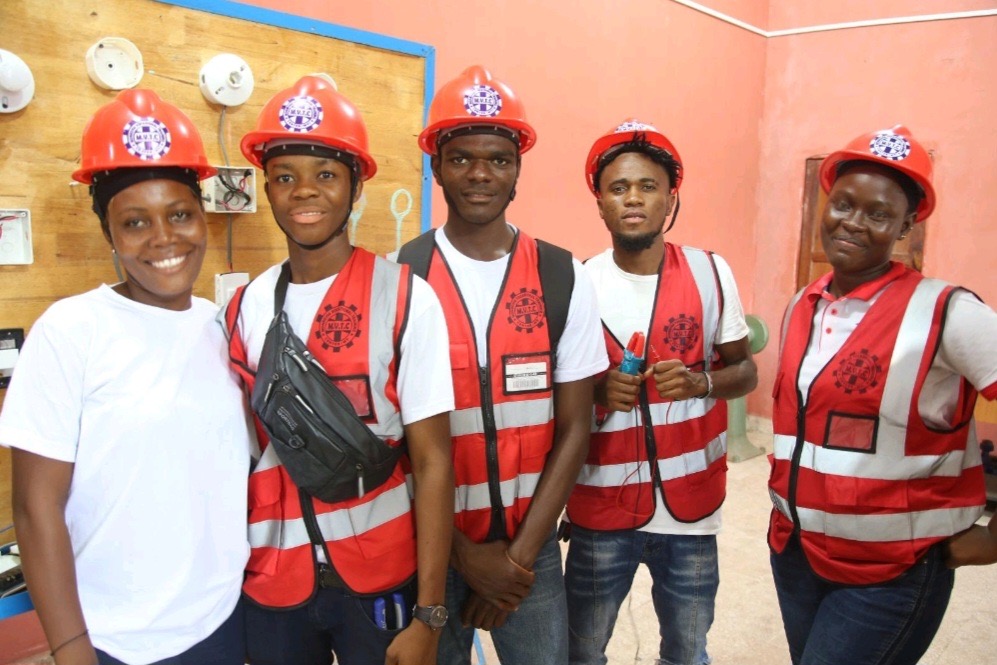
One of the clearest examples is emerging at the Monrovia Vocational Training Center (MVTC), where students in electrical training are said to be gaining structured, hands-on experience designed to prepare them for real workplace demands.
Recent interviews with trainees and trainers indicated that there are changes at the institution.
For trainee Faith Wilson, the transformation has been personal, and having entered MVTC with virtually no knowledge of electrical work, she can now connect single-pole circuits, receptacles and switches and perform basic installations independently.
The EUR10 million Strengthening Integration through Vocational Education (STRIVE) Project is funded by the Agence Française de Développement (AFD) and implemented by the European Institute for Cooperation and Development (IECD).
It seeks to strengthen skills development and economic inclusion while improving young Liberians’ employability, as at MVTC, the project has helped introduce a structured electricity curriculum, addressing a longstanding gap in the training program.
Assistant Director for Training at MVTC, Stanley S. Karmo said electrical instruction previously operated without a dedicated curriculum, leaving practical training less structured.
He said the new curriculum has brought greater quality and organization to training, enabling students to understand what they are expected to learn, demonstrate and master before advancing.
The transformation also extends to instructors, as Electrical trainers have received pedagogical and technical support, including training in lesson planning, curriculum implementation, schemes of work and learner-centered teaching.
The Head of the Electrical Shop at MVTC, Ecarus K. Douglas said the new approach has shifted classrooms from instructor-dominated teaching toward demonstrations, student participation, group learning and extensive hands-on practice.
December McCooper, another electricity instructor, said the competency-based approach taught him that instructors should create opportunities for students to perform tasks themselves rather than simply listen to lengthy explanations.
The project is also helping challenge traditional perceptions about women and technical trades, as Wilson said her experience has changed her understanding of what women can achieve, giving her confidence to pursue electrical work as a career.
Meanwhile, a STRIVE-IECD beneficiary, Reuben J. Donkpain said his vocational training helped him identify a business opportunity after observing that people in his community had to travel long distances to obtain electrical materials.
The STRIVE intervention has also supported equipment and infrastructure improvements at MVTC and other vocational institutions, including LOIC Monrovia, Maryann Cheeseman, AVTP, BWI, LOIC Buchanan, Tumutu Agricultural Vocational Training Centre and LOIC Gbarnga.
For MVTC authorities, however, the ambition goes beyond basic electrical training, as the institution wants to expand into industrial electricity, solar technology, programmable logic controllers (PLCs), simulation and other modern technologies increasingly demanded by industry.
Karmo said the ultimate goal is to produce graduates who can either secure employment or establish businesses capable of creating jobs for themselves and others.
With thousands of young Liberians entering the labor market each year, the STRIVE model is placing renewed emphasis on a simple but powerful idea, that TVET should not end with a certificate, it should equip young people with the confidence and practical skills to earn a living, build businesses and create opportunities for others.
