
— As the National Museum Looks on
By: Jonathan O. Grigsby, Snr./Contributor Writer
National Museums around the world serve as the ultimate guardians (custodians) of nations’ tangible and intangible heritage.
The National Museums collect, conserve and exhibit artifacts that might otherwise be lost to time, ensuring that the stories, achievements, and challenges of past generations are re-made for future generations.
These museums play a critical role in shaping national identity, fostering education, driving research, and positioning a country or nation within the global cultural landscape. And these points mentioned above cover the operations and functions of countries which have museums, and of course, Liberia is no exception.
The above introduction has led me to the National Museum of Liberia, situated on Board Street, close to the Centennial Pavilion, which sole responsibilities are protecting the nations’ tangible and intangible heritage.
Historical Background of the National Museum of Liberia
The National Museum of Liberia is where all historical artifacts of Liberia that are significant and vital to Liberia and its people are kept for exhibition and research, among others.
The Museum was initially housed in the First Executive Mansion on Ashmun Street in Monrovia, which is now used as a library, it was established by an Act of the National Legislature in 1958 under the Administration of Liberia’s 18th President, William V.S. Tubman.
It was partly funded by United Nations Education Scientific and Culture Organization (UNESCO) in coordination with the Department of Public Instructions (now the Liberian Ministry of Education).
Its primary goal was to obtain, preserve and display cultural artefacts and other historical items which depict Liberia’s rich heritage.
The museum remained under the Department of Public Instructions until 1965 when it became the responsibility of the Department of Information, Cultural Affairs and Tourism (MICAT).
In 1981, it was detached to form the National Bureau of Culture & Tourism of which the museum operated through the 1980s until June 1987 when it was dissolved and returned to the control of the Department of Information.
In 1972, the museum was relocated to a new building on Providence Island but four years later this building was removed to facilitate the construction of the People’s Bridge over the Mesurado River.
Before the Civil War, the National Museum of Liberia was Intact
The National Museum of Liberia over the past decades did well in keeping many artifacts of the country, dating back to the settlers’ arrival up to the 1980 coup and through to the 1990 war, which lasted for nearly 14 years, when some of those items were taking away by unscrupulous individuals.
Government’s documents, cultural and traditional artifacts, cassette recordings, newspapers, magazines, and other important materials, including national and international treaties were all intact at the National Museum of Liberia before the outbreak of the country’s civil unrest.
Effects of the Liberian civil war on the National Museum of Liberia
The National Museum of Liberia, which was the custodian of the country’s rich heritage was deeply affected during the First and Second Liberian Civil Wars.
Reports revealed by one of the Museum’s Directors, Caesar Harris that approximately five thousand artifacts were looted during this period and now less than 100 larger artifacts remain.
So there is a need for relevant government ministries and agencies to work to have those artifacts traced and recollected to have them placed in the museum, as other countries around can ensure that artifacts or printings missing from their museums are found.
The reasons of going after those lost artifacts and other items and materials are to keep their heritage intact. I guess, when the museum authorities exert all efforts, Liberia can retrieve some of those things that were looted.
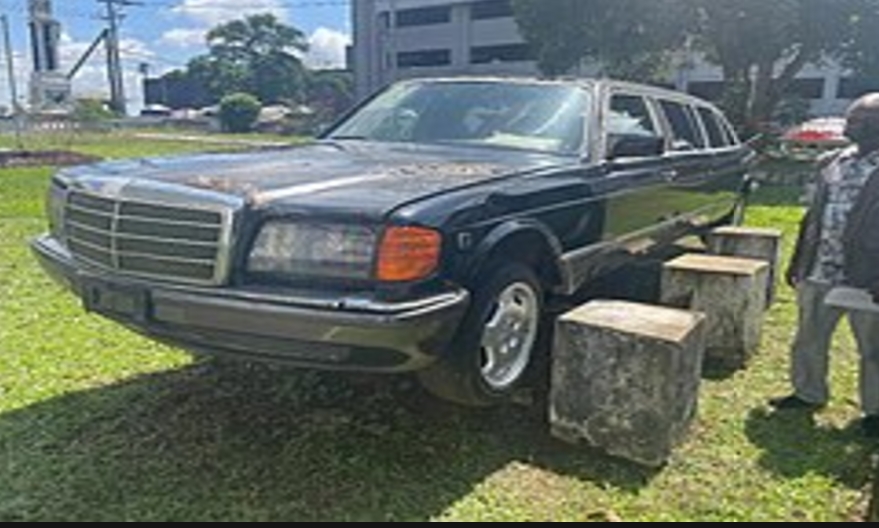
The Poorly Conserved Three Former Presidential Vehicles: Tubman, Doe and Taylor
Now, whatsoever that are placed in the museum should be conserved properly, because they are of significance to the nation, its citizenry and people around the world.
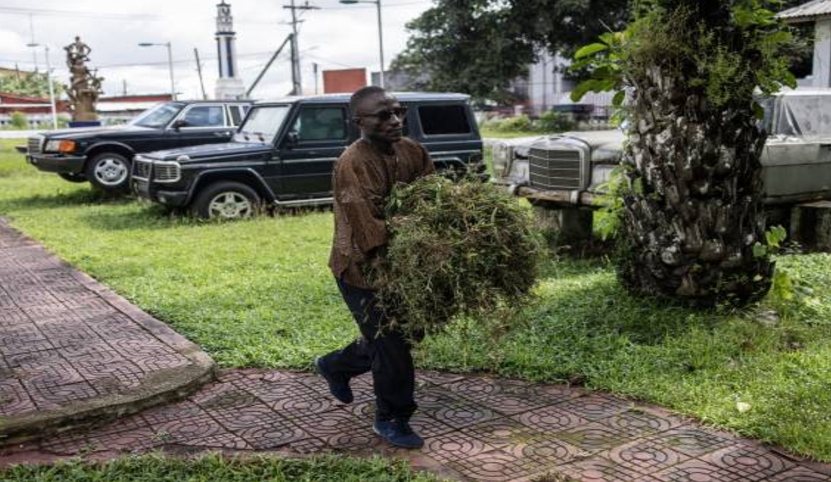
But from my observation, there are other artifacts that are well taking care of; while others are not. The once uncared for are the “Three Former Presidential Vehicles”, at the back of the National Museum of Liberia building and on the left side when you are entering the grounds of Centennial Pavilion on Ashmun Street.
However, sadly, whenever I passed by the National Museum located on Broad Street in Central Monrovia, I always developed a mental and physical picture of the “Three former Presidential Vehicles” at the back of the museum, where the vehicles are kept in the open.
For now, since the “Three Presidential Vehicles” are placed in the National Museum of Liberia, proper care needs to be taken of them. Those vehicles needed to be maintained, to keep them in their original shape because people will visit the museum to see them.
Besides, the vehicles needed to be kept in a place of preservation where they will not get rotten.On the contrary, look at the present condition of the “Three Former Presidential Vehicles”, where they are placed and positioned.
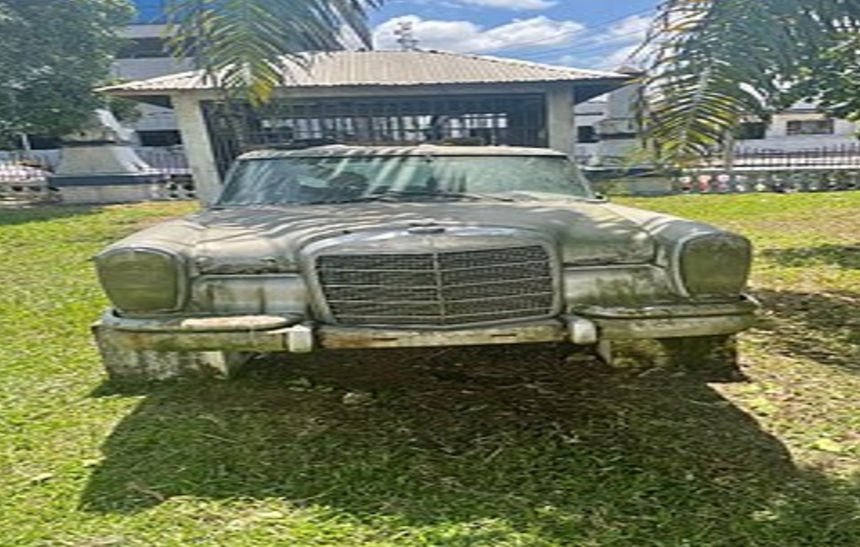
It shows that we as a nation and people are not serious in conserved those vehicles, which are in the custodian of our National Museum.Look at the current conditions of the limousines used by the 18th and 19th Presidents of Liberia: William V.S. Tubman and Dr. Rev. William R. Tolbert.
Anyone visiting the museum and seeing the conditions of the Tubman and Tolbert limousine they will know that, that it should be scrapped, which does not augur well for the country’s museum. It is because the vehicle is poorly handled.
Despite placing the vehicle up on solid blocks, all the tyres are gone, the seats, lights, and wind shields, among other parts, are not in good conditions. The limousines had greatly depreciated.
For those of Former President Samuel K. Doe and Charles MacArthur G. Taylor are still better, but keeping them in the open, where the sun and rain, dew and the dust will keep them in the open will get them rotten and is improper.
President Doe’s limousine outside body is good yet, but the seats and other interior parts are gradually depreciating.
I do not know whether it is still in a moveable condition. To some extent, the “Three Presidential Vehicles” should be moveable and in a perfect shape where tourists who visit Liberia and its museum can take pictures both inside and outside and funding could be generated from that. They should have been in a closed place, where people will go in to view.
The Tubman and Tolbert limousines are out and if nothing is done by authorities at the National Museum, in the not too distance future, the Doe and Taylor limousine and bulletin proof G Wargon will be out also. So then, why is the need of us putting the “Three Former Presidential Vehicles” in the National Museum of Liberia?
In conclusion, I do not want to go outside of African to talk about museums in Europe, the United States, Asia, and the Middle East.
Visit the museums in Ghana, South Africa, Rwanda, Egypt and Ethiopia and see how their artifacts and other materials are handled and taking care of.
So, in short, I am pleading with authorities of the National Museum of Liberia to rethink about conserving our “Three former Presidential Vehicles “for posterity.This is my little thought on: Our Three Former Presidential Vehicles are not Properly Conserve: “As the National Museum Looks on”
