



Monrovia -As Liberia struggles to outlaw the practice of Female Genital Mutilation, several efforts by activists and women advocates get defeated whenever pieces of legislature seeking to outlaw FGM get defeated at the Liberian legislature.
This time, with another draft bill which emerged from the office of President Joseph Boakai, known at the Girls and women protection Act of 2025 is again seeking to end the practices.
It can be recalled, in 2019 members of the Legislature removed FGM Component from the Domestic Violence law, passing the law without abolishing FGM. The debate dragged on.
Some lawmakers feared that abolishing FGM would me losing support from traditional communities during elections, others argued that that FGM remains but that women and girls who reach the age of 18 go to the Sande Bush at the age of consent, however, law makers still trashed it complete from the then Domestic Violence Act. Since 2019 to date, Liberia has yet to abolished FGM.
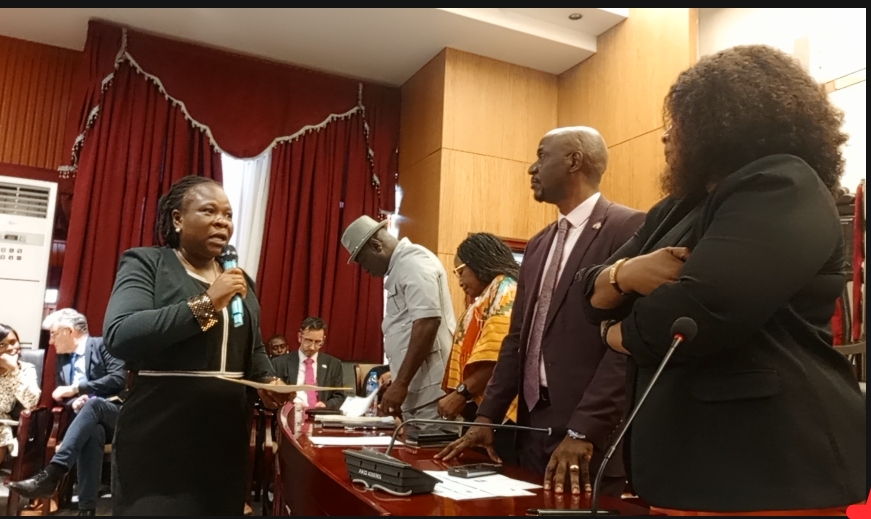
Recently, the National Coalition Against Harmful Practices (NACAHP) and partners met and held talks with members of the 55th legislature to present detailed findings (report) from a study conducted on FGM across the country.
At that meeting, Liberia’s Deputy Minister for Gender at the Ministry of Gender, Children and Social Protection, Laura Golakah reiterated to members of the Legislature that setting age limit of 18 years as consent for a girl to make decision whether or not go at the traditional school, still puts girls in harm ways.
The disagrees with such argument. Here is what she said and I want you to do a short write up on Minister Laura Golkeh points she stroke to members of legislature.
As debates on Capitol Hill progress since President Joseph Boakai presented the draft Girls and Women Protection Act, which seeks to permanently ban Female Genital Cutting or Mutilation (FGM), scores of rights activists and campaigners continue to engage with member of legislature to ensure its passages.
One such group is the National Coalition Against Harmful Practices (NACAHP).
At a one-day public engagement with mem members of the house of representatives, NACAHP’s executive director told members of the House of Representatives that now is the time to do this singular favor for Liberian girls and women, by passing the Protection Act save girls and women from the age long practice of women circumcision; globally known as female genital mutilation (FGM)Liberia’s House of Representatives has pushed the Female Genital Mutilation (FGM) Bill into the national spotlight following a massive joint-committee public hearing that brought together lawmakers, traditional leaders, women’s groups, and international partners in a tense but hopeful showdown over the future of girls in the country.
This is no longer just a cultural debate; it is a matter of life, dignity, and human rights. The hearing came after five-county community consultations with rural women, traditional authorities, and civil society organizations, whose collective message was clear: FGM must stop.
Development partners including the European Union, UN Women, and the Ministry of Gender, Children and Social Protection reviewed findings showing strong grassroots support for a law that prioritizes health, safety, and protection.
Held under the banner “Born Perfect Grand Finale: From Community Dialogue to National Action,” the forum revealed that many citizens now see FGM as harmful and outdated. “Our girls are not born to suffer in silence,” a women’s advocate told the hearing. “They are born perfect and deserve to grow without fear.”
Providing scientific backing to the emotional testimonies, Medica Liberia presented a five-county baseline survey showing a growing rejection of FGM.
The data confirms what women have been saying for years this practice endangers health and violates basic rights.
Delivering the official position of the Joint Legislative Committee, Rep. Moima Briggs-Mensah said the proposed Women and Girls Protection Act is designed to protect lives, not attack culture.
According to her, the law must be firm in protecting rights, but respectful in how it engages in the communities.
She stressed that real change requires culturally sensitive messaging, grassroots involvement, and strong support systems such as education, healthcare, and alternative livelihoods.
The lawmaker warned that a law without support will fail, but a law backed by communities will transform the nation.
Some lawmakers, however, called for the consultations to go beyond five counties if they truly want to succeed.
As the debate intensifies, the House has made one thing clear: the future of Liberia’s women and girls is now at the center of legislative action. “History will judge us by whether we stood up for our daughters or looked away,” a lawmaker said, as the country waits for what could be a defining vote.


