



–As Help Giver Cries Out for Help
By Mark N. Mengonfia
Monrovia-The Liberia National Red Cross Society, an institution established to help, is now crying to get its “little allotment” from the government of Liberia to meet needs.
The Liberia National Red Cross Society (LNRCS) was first established as Voluntary Relief Committee (VRC) at the end of World War I in January 1919 but later in 1922, the Legislature passed a joint resolution to give the VRC a legal status to be recognized by the International Red Cross and Red Crescent Movement. The mission among other things are to render assistance to the medical services of the armed forces of Liberia in times of armed conflict, to prevent and alleviate human suffering with complete impartiality, making no discrimination as to nationality, race, gender, religious beliefs, language, class or political opinions.
This mission is now left with partner institutions to be achieved as the government of Liberia has reportedly abandoned its own brainchild.
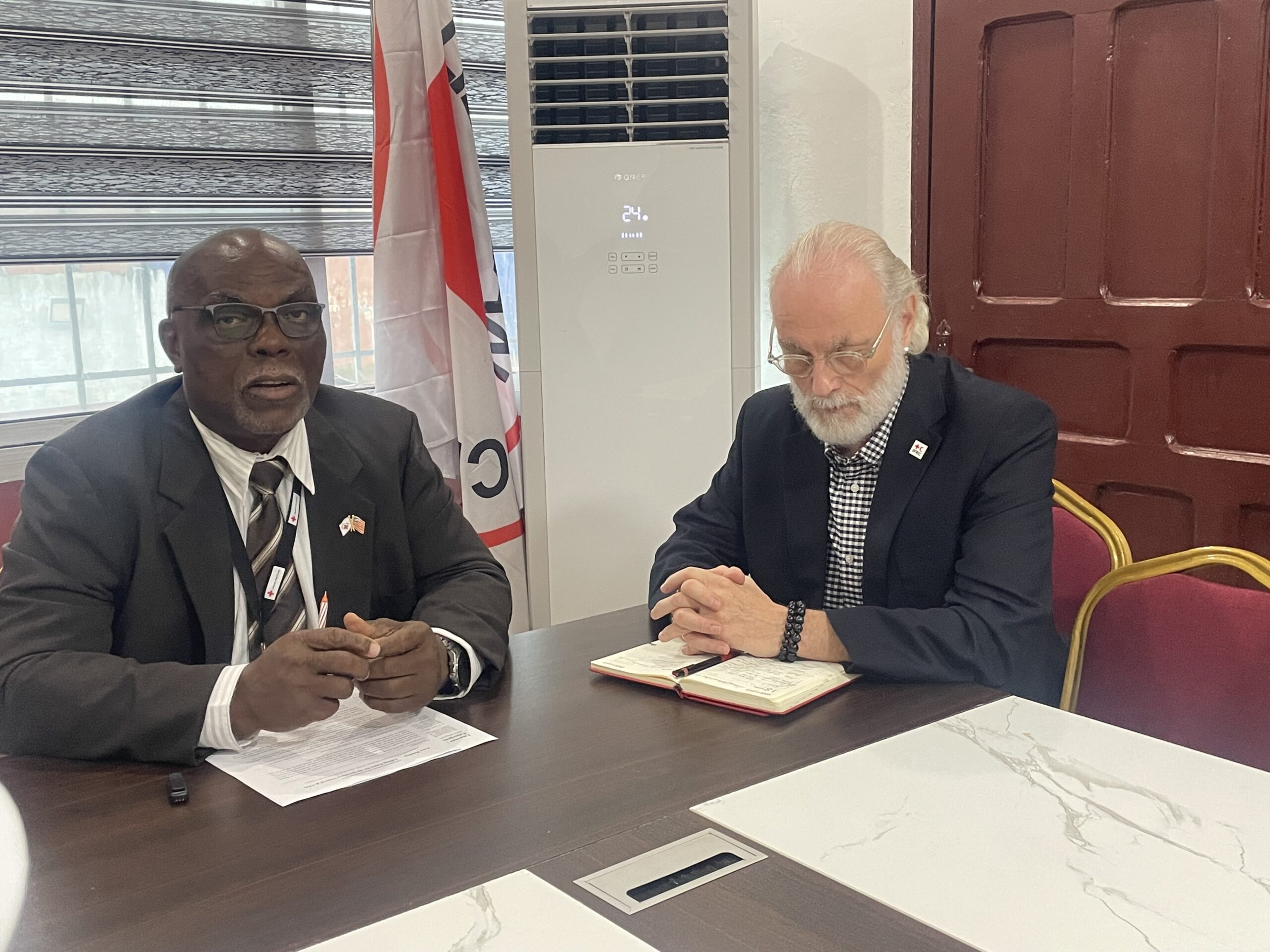
At a press conference Tuesday, September 22,2026, LNRCS Secretary General and CEO Gregory T. Blamoh reiterated the institution’s calls for support to help achieve the reason it was established.
The situation has reached a point that the institution has to write to local businesses, government ministries and agencies seeking support to help those affected people but the efforts have proven unsuccessful.
“This is the situation we are facing, ok. Because had we gotten additional support from those companies and corporations and government ministries and agencies that we knew could help, we would have reached more people” Mr. Blamoh said.
When he was asked about the allocation by the government in the National Budget, he said, “We are still crying and that is the truth”
He added, “The truth of the matter is we have not gotten much from the government. I have told you before and I will say it again.”
The government of Liberia allotted the sum of forty-thousand Dollars (40,000.00) in the National Budget for the humanitarian institution to respond to situations like flooding, storm or fire disasters.
Out of said money, the government of Liberia has not been able to provide in full or 50% of it.
“As of this point, September 22,2026, we have only received ten-thousand (10,000.00) and I do not know when we are getting the balance of thirty-thousand (30,000.00)” he added.
He said as an institution, they are still engaged and are still talking to relevant authorities with the most recent being the Speaker of the House of Representatives, Richard N. Koon although he didn’t say what the outcome of the meeting was.
Still hopeful, he said, “Like you, I am waiting for something to happen.”
With all that is happening, the institution has not given out on its responsibilities but is reaching out to partner institutions to help those affected by either flooding, fire or storm disasters.
With support from partners, the Liberia National Red Cross Society (LNRCS) at the Tuesday’s conference said it will increase its spending on humanitarian aid to over one million one hundred forty-four thousand United States Dollars on emergency relief this year, as it launches its third disaster response of 2026, this time for families affected by widespread flooding across six counties to serve over 7-thousand 5-hundred people.
The milestone caps a year in which the Liberian Red Cross has moved quickly, one disaster after another, to reach thousands of Liberians left without homes, food, or clean water.
A Track Record Built on Two Completed Responses
The flood response is the latest in a series of interventions that have already changed conditions on the ground for thousands of families. The Liberian Red Cross has completed its windstorm response, delivering cash assistance and shelter construction materials support to 2,792 people (213 families)in Nimba and Lofa Counties. Separately, 1,643 people (176 families) affected by fire outbreaks have also received cash assistance and shelter construction materials support across Montserrado, Margibi, Nimba, Rivercess and Grand Cape Mount counties.
Together, these first two responses of the year demonstrate what the Liberian Red Cross model delivers in practice: rapid cash assistance that lets affected families meet their own immediate needs, paired with shelter support for those whose homes were destroyed-restoring a measure of stability within weeks of disaster striking, rather than months.
A Third, Larger Emergency: The August Floods
In August 2026, Liberia experienced a prolonged period of exceptionally heavy rainfall that overwhelmed rivers, drainage systems and waterways, triggering severe flooding across multiple counties at once. Margibi, Montserrado, Grand Cape Mount, Bong, Nimba and Grand Bassa were among the areas hit hardest.
Preliminary assessments paint a picture of a major humanitarian emergency: more than 76,000 people from over 15,200 households were affected, and more than 5,000 people were displaced from their homes. Thousands of houses, schools, health facilities, community structures, and livelihood assets were damaged or destroyed, and floodwaters contaminated water sources and damaged roads, bridges, and local markets.
Urgent Needs on the Ground
Rapid assessments conducted by LNRCS, through its local offices and partners, found needs too broad for any single form of assistance or agency to address. Affected households have lost food stocks, household belongings, productive assets and sources of income – particularly families dependent on agriculture, petty trading, fishing and daily wage labour – sharply raising the risk of food insecurity and prolonged hardship.
Contaminated water sources have increased the risk of waterborne disease and malaria, and many families now face competing priorities all at once – food, drinking water, medicine, hygiene supplies, clothing, transportation, temporary shelter and materials for minor household repairs. Assessments also point to growing psychosocial distress among affected populations, and 350 households were identified whose homes were destroyed or so severely damaged that they are unsafe to live in, leaving those families exposed to prolonged displacement.
The Red Cross Response
Under the emergency flood response, the Red Cross will provide unconditional cash assistance to 1,375 families with a total of 7,525 people) to cover basic needs such as food and essential non-food items necessary for family upkeep. An additional 350 of those families, whose homes were badly damaged, will receive further cash assistance to help them rebuild and/or repair these houses.
The response also includes repair of damaged hand pumps and wells, procurement and distribution of water treatment chemicals, and distribution of mosquito nets in affected communities – directly targeting the contamination and disease risks the assessments identified.
The Emergency Flood response is jointly funded with a further 584-thousand United States Dollars by the IFRC Disaster Emergency Response Fund (DREF) and Swedish Red Cross Initial Respond. The Emergency Response is covering six counties including Bong, Nimba, Grand Bassa, Montserrado and Grand Cape Mount and Margibi, reaching a total of 1,375families and over 7,525 people. Local Red Cross offices in these counties have already carried out rapid initial assessments. As the response gets under way, these will be followed by more detailed assessments and physical verification, with beneficiary selection criteria clearly explained to communities before any data is collected. Nearly 45 percent of the IFRC-funded DREF is covered by the European Union with over 230-thousand United States.
“We Move as Fast as the Need Demands”
Speaking on the launch of the flood response, LNRCS Secretary General and CEO Gregory T. Blamoh said:
“Three emergencies in one year are a heavy burden for any community to carry, and they are also a heavy burden for us to respond to as an organization. But this is exactly why the Liberian Red Cross exists – to move as fast as the need demands. Over one million dollars in assistance is not just a figure; it is relief for thousands of families who do not have to face fire, windstorm and flood alone. As we begin this flood response, our commitment to the people of Margibi, Montserrado, Grand Cape Mount, Bong, Nimba and Grand Bassa is the same commitment we made in Nimba, Lofa, Rivercess and every county before them: we will be there, and we will to our best to help in your time of need.”
The Liberian Red Cross Society’s disaster response efforts have been supported by the International Federation of Red Cross and Red Crescent Societies (IFRC), the European Union, the Swedish Red Cross (SRC), and the Government of Liberia. The invaluable contributions of Red Cross volunteers have also been instrumental to the success of emergency response operations, particularly in delivering timely assistance and support to affected communities.
“We are deeply grateful to the IFRC Disaster Emergency Response Fund, the European Union and the Swedish Red Cross for making these responses possible; their support means families do not have to wait for help to arrive. We also thank the local authorities in each affected county for their close coordination and collaboration, which allows us to reach communities quickly and safely. And above all, we thank our volunteers – spirited, passionate young men and women who are often the first on the ground, reaching affected families and understanding their needs within seconds of a disaster striking. This response belongs to them as much as it does to us”, Mr. Blamoh added.
Looking Ahead
With the flood response now under way, LNRCS teams will continue detailed assessments and verification in the coming weeks to ensure that the assistance reaches those with the most urgent needs first. The Liberian Red Cross continues to call on partners and the public to support its emergency response work as Liberia recovers from one of its most demanding disaster years in recent memory.


