



By Mark Mengonfia
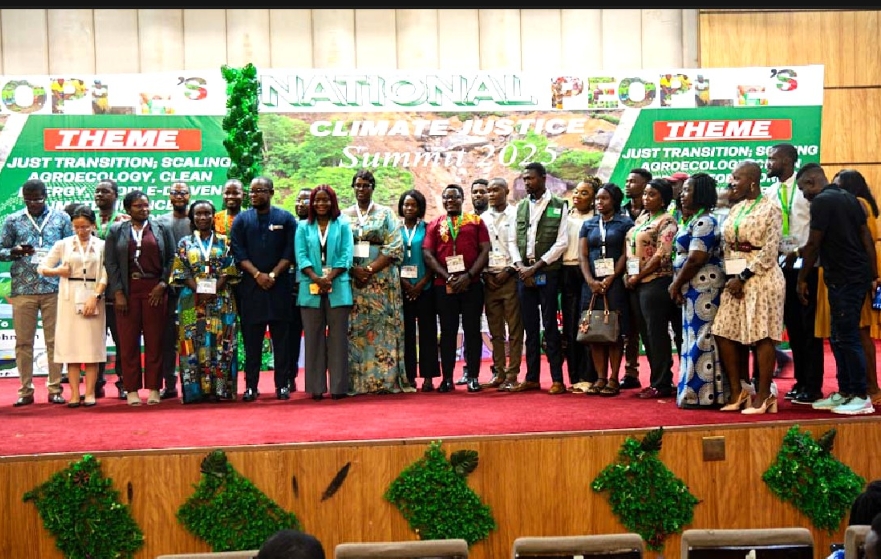
Monrovia, Liberia –The 2025 National People’s Climate Justice Summit officially ended with ActionAid Liberia and its national and regional partners presenting a unified communiqué to the Government of Liberia, calling for urgent,people-centered actions to confront the country’s worsening climate challenges.
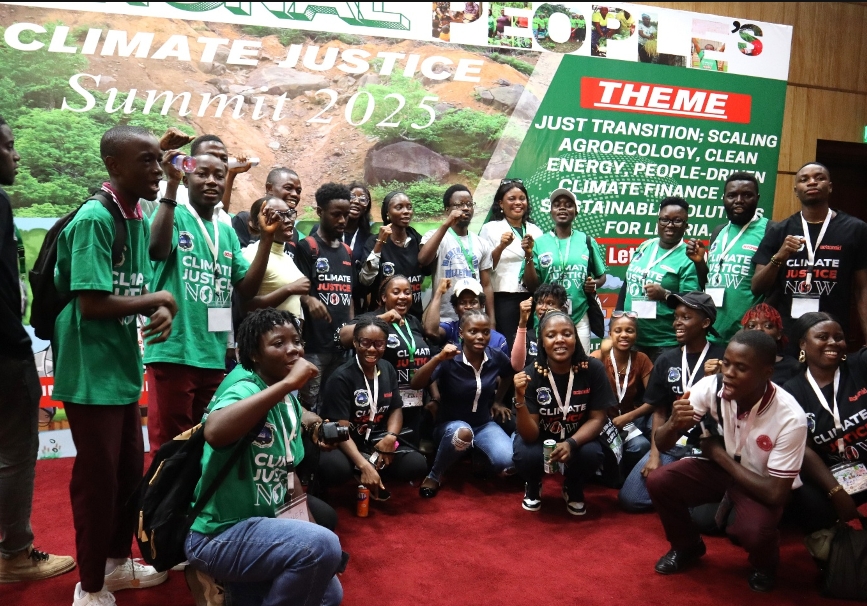
The two-day summit, held from December 15–16, brought together more than 1,000 delegates from across Liberia and West Africa, including members of the ActionAid Federation.
Participants represented government ministries and agencies, the Legislature, civil society organizations, women and youth movements, farmers’ groups, the private sector, academia, the media, and development partners.
Held under the theme “Just Transition: Scaling Agroecology, Clean Energy, People-Driven Climate Finance and Sustainable Solutions for Liberia,” the summit provided a platform for inclusive dialogue on climate justice, equity, and sustainable development, with a strong focus on solutions driven by affected communities.
At the close of the summit, participants formally adopted and presented a joint communiqué to the Government of Liberia.
The document, read and delivered by Madam Loretta Pop Kai, Head of the National Civil Society Council of Liberia, outlines key demands and commitments aimed at advancing climate justice while strengthening national resilience.
Summit participants acknowledged progress made since the 2024 National Stakeholder Summit on Climate Justice, particularly increased government engagement around agroecology, climate finance, and inclusive processes linked to Liberia’s Nationally Determined Contributions (NDCs).
However, they emphasized that Liberia despite its minimal contribution to global greenhouse gas emissions continues to face severe climate impacts, including flooding, coastal erosion, food insecurity, land degradation, and climate-induced displacement.
Agriculture featured prominently in the communiqué as both the backbone of Liberia’s economy and one of the sectors most exposed to climate shocks.
While agriculture contributes approximately 36 percent of GDP and employs over 60 percent of the population, participants noted that agroecology proven to boost yields, restore soil fertility, and strengthen food sovereignty remains underfunded and insufficiently prioritized.

Concerns were also raised about climate finance failing to reach local communities, women-led organizations, and youth-driven initiatives as well as limited access to renewable energy and green jobs, particularly in rural areas where electricity access remains extremely low, was cited as a major barrier to inclusive development.
The communiqué called for a decisive shift toward agroecology, improved accountability within the Comprehensive Africa Agriculture Development Programme (CAADP), expanded people-driven climate finance mechanisms, a just energy transition, strengthened disaster preparedness, and the full domestication of COP30 outcomes aligned with Liberia’s NDC 3.0.
Women and youth identified as those most affected by climate change yet least represented in decision-making were placed at the center of the summit’s demands.
Participants urged reforms in land governance, climate finance delivery, and disaster response systems to ensure gender-responsive and youth-inclusive approaches.
The communiqué was unanimously endorsed by summit participants, who pledged to sustain advocacy efforts, monitor progress, and publicly report on the implementation of the agreed actions.
Receiving the communiqué on behalf of the Government of Liberia, Deputy Director of the Environmental Protection Agency, Anthony Kollie, commended the summit, describing it as a reflection of the nation’s collective conscience.
“Climate justice is not optional for Liberia,” Kollie stated, noting that the country is already experiencing unpredictable rainfall patterns, declining soil fertility, flooding, coastal erosion, and climate-induced displacement.
He stressed that climate finance must move beyond policy discussions and international conferences, emphasizing that resources should reach women farmers, youth entrepreneurs, and frontline communities at the village level.
Kollie further committed to presenting the communiqué to the government for consideration.
The National People’s Climate Justice Summit, organized annually, serves as a space for honest reflection on progress since previous summits, review of commitments, and assessment of engagement with key government institutions.
This second summit builds on the foundation laid during the inaugural National Climate Justice Summit in late 2024, which set an ambitious agenda for scaling agroecology, accelerating renewable energy, and advancing people-driven climate finance.
That first gathering strengthened collaboration between civil society and government and marked a milestone for women’s and youth inclusion in Liberia’s updated climate commitments under NDC 3.0.


